Living in Cambridge, MA: An Essential Guide for Young Professionals
Explore Cambridge, MA’s Kendall, Central & Harvard vibe: 7 sq mi, 5 Red Line stops, 70 parks, $2,992 1-bed rent, $866K condo median.
Written ByAndrew McKinney
PublishedOctober 17, 2026
I'm Andrew McKinney, a JD/MBA attorney and broker helping buyers and sellers in Boston, Newton, Cambridge and beyond. Let's talk, from first search to closing. Serving Boston, Brookline, Cambridge, Arlington, Needham, Newton, Waltham, Lexington, Wellesley, Medford, Dedham, Westwood and Natick, MA.
Cambridge, MA
Region
In July 2026, the median sale price for homes in Cambridge, MA was $1,045,000, up 1.5% from a year earlier.
Cambridge fits world-class universities, one of the country's densest innovation economies, and a lively, walkable street life into about seven square miles just across the Charles from Boston. If you're early in your career and want to walk to work, ride the Red Line everywhere else, and still find a good happy hour on a Tuesday, this guide covers the vibe, the housing, the gathering spots, and the commute as of October 2026.
Is Cambridge, MA a good place for young professionals to live?
Yes. Few places in Greater Boston suit young professionals as well as Cambridge does. It pairs a busy, intellectual urban energy with direct access to tech, biotech, and academic employers. Nearly everything is reachable on foot, by bike, or on the Red Line.
About 116,000 residents share the city with roughly 42,000 full-time students. That's why the cafés, bookstores, and bars stay busy at all hours. On top of that sits an employment base no other part of the region can match. Greater Cambridge hosts around 1,000 biotech and tech companies, and Kendall Square anchors some of the largest lab commitments in the market. Sanofi recently signed for 900,000 square feet at Water Street.
What is the vibe like in Cambridge, MA: quiet or busy?
Busy, but the busyness is walkable and built to a neighborhood scale, without the skyscrapers. Each "square" has a personality of its own:
•Kendall Square: glass towers, startups, MIT, and rooftop lounges. On weekdays it's polished and fast-moving.
•Central Square: music venues, murals, diverse dining, and a creative, slightly gritty energy that runs late.
•Harvard Square: historic brick, bookstores, coffee shops, and street performers.
•Inman and Porter Squares: more neighborhood charm, with independent shops and strong local restaurants.
When I tour homes with clients who work in Kendall, their first question is rarely about square footage. It's "which square feels like me?" The person who wants to catch a set at The Cantab Lounge after work usually ends up near Central. The person who wants quieter weekends and a good bookstore leans toward Harvard or Porter.
For all its density, Cambridge feels surprisingly calm. Most streets carry a 20 mph standard speed limit, and the city maintains around 70 public parks and playgrounds. The streets were built for people as much as for cars.
What does it cost to live in Cambridge, MA in 2026?
Cambridge is expensive, though the picture is more nuanced than its reputation. Condos are the most practical path to ownership, renting is common, and the property tax rate is among the lowest in the region.
Cambridge, MA July 2026 Housing Snapshot
Current MLSPIN figures show a condo market with a median sale price of $866,611 and 7.9 months of supply, giving buyers more room than the city’s tighter single-family and multi-family segments.
Condo/Townhouse
Median Condo Sale Price (July 2026, MLSPIN)$866,611
A one-bedroom averages about $2,992 a month, and rents climb steeply with each additional bedroom. Roughly 66–67% of Cambridge housing units are renter-occupied, so renting first puts you squarely in the majority.
What Does It Cost to Rent in Cambridge, MA?
Recent rental averages reported by Zenith Residential Properties show a steep bedroom-count premium, from $2,992 per month for a 1-bedroom to $7,209 per month for a 4-bedroom.
Recent rental averages reported by Zenith Residential Properties show a steep bedroom-count premium, from $2,992 per month for a 1-bedroom to $7,209 per month for a 4-bedroom.
Recent rental averages from Zenith Residential Properties:
•1 Bed:$2,992/mo
•2 Bed:$3,948/mo
•3 Bed:$5,058/mo
•4 Bed:$7,209/mo
The numbers reward roommates. Split two ways, a 2-bedroom costs well under a solo 1-bedroom. A 4-bedroom shared by four is cheaper per person still, although those units tend to take a little longer to lease.
Is it a good time to buy a condo in Cambridge, MA?
Buyers have more leverage now than they've had in years, particularly in the condo segment. As of July 2026, MLSPIN data for Cambridge condos and townhouses shows:
•Median sale price:$866,611
•Median days on market:34 days
•Months of supply:7.9 months
•Active listings:407
Anything above seven months of supply favors buyers. You can tour across several weekends, compare buildings, and negotiate on inspection items, which simply wasn't realistic a few years ago. Inventory has loosened considerably since the ultra-tight market of 2022, and condos now carry more supply than single-family or multi-family homes:
How Buyer-Friendly Is Cambridge, MA Inventory by Property Type?
Months of supply varies widely by segment in July 2026: condos have the most available supply at 7.9 months, while multi-family inventory remains comparatively tighter at 3.8 months.
Months of supply varies widely by segment in July 2026: condos have the most available supply at 7.9 months, while multi-family inventory remains comparatively tighter at 3.8 months.
For comparison, as of July 2026, single-family homes posted a median sale price of $1,660,000 (42 median days on market, 5.5 months of supply). Multi-families came in at a median of $2,180,000 (37 days, 3.8 months of supply). For most young professionals, Cambridge ownership starts in the condo market.
Are property taxes high in Cambridge, MA?
No. At $6.67 per $1,000 of assessed value, Cambridge's FY2026 residential rate sits well below its neighbors'. Commercial and lab properties carry much of the tax burden, which keeps residential bills down.
Cambridge, MA Residential Tax Rate vs. Nearby Markets
Cambridge’s FY2026 residential tax rate is reported at $6.67 per $1,000 of assessed value, lower than several nearby Greater Boston communities in this comparison.
Cambridge’s FY2026 residential tax rate is reported at $6.67 per $1,000 of assessed value, lower than several nearby Greater Boston communities in this comparison.
Somerville's rate is $10.98, and Boston's is $12.40. On a median-priced condo, that difference adds up to real monthly savings. When buyers are weighing a Cambridge condo against a similarly priced unit across the river, I always run the carrying costs side by side. The tax difference often closes more of the price gap than people expect.
What types of homes are available in Cambridge, MA?
You'll find sleek mid-rise condos, converted triple-deckers, industrial lofts, and historic Victorian and Greek Revival townhomes, most of them on compact urban lots. Condos account for about 27.6% of all dwelling units in the city.
What are condos and lofts like in Cambridge, MA?
Newer luxury condos cluster in East Cambridge, Kendall, and North Point. Loft conversions occupy former industrial buildings along the old manufacturing corridors. Here's what to expect:
•Mid-rise luxury buildings: elevators, concierge or package rooms, fitness centers, roof decks, and often garage parking, which is valuable because street parking is tight.
•Industrial loft conversions: high ceilings, exposed brick and timber, and oversized windows.
•Converted triple-deckers and two-families: the classic Cambridge condo. These are often floor-through units with porches, sometimes with deeded yard space or a basement storage cage. Fees tend to be modest. Associations are small, though, so review reserves and building condition carefully.
Updated units command a real premium over those that need work. If you're comfortable with a cosmetic refresh, a dated unit is one of the better value plays in the city.
What are historic townhomes like in Cambridge, MA?
Most of Cambridge's 19th-century brick rowhouses and Victorian and Greek Revival homes are in Mid-Cambridge, Cambridgeport, and the streets around Harvard Square. Expect original moldings, bay windows, and narrow footprints. Many of these homes sit within historic or conservation districts, where exterior changes may require city review. Plan for that if you have renovations in mind.
How big are typical lot sizes in Cambridge, MA?
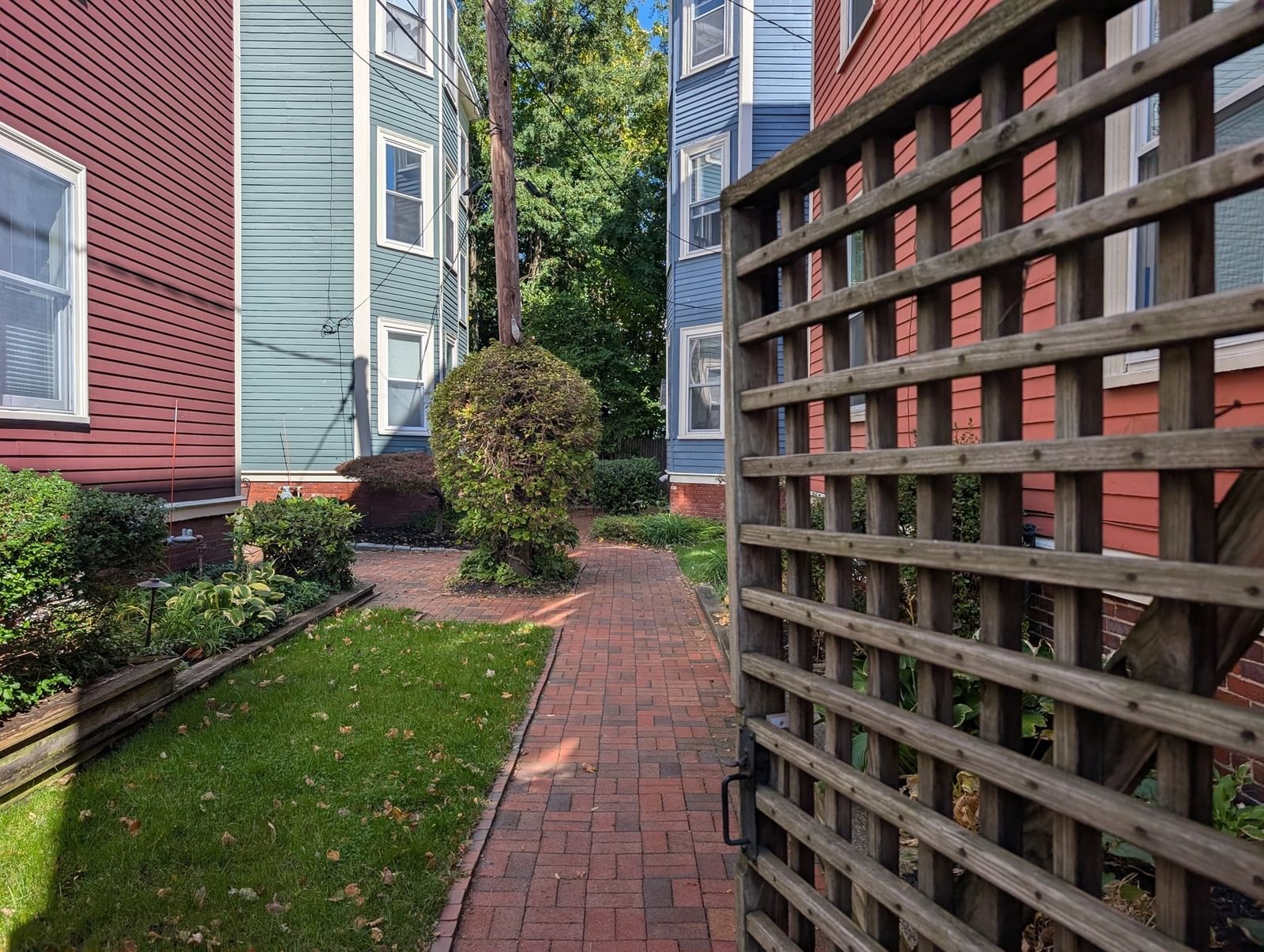
Lots are small and efficient, because the city was designed around walkability, not yards. Most residential parcels hold attached or closely spaced homes. Outdoor space usually means a shared yard, a porch, a roof deck, or the nearest park rather than a private lawn.
That could change over time. In February 2025, Cambridge adopted sweeping citywide multifamily zoning changes:
Cambridge, MA Multifamily Zoning Changes
Cambridge’s February 2025 multifamily zoning update expanded by-right residential capacity, including 4-story standard development rights and a 6-story option tied to inclusionary housing requirements.
Zoning Petition Adoption DateFebruary 10, 2025
Standard Building Height4 stories
Maximum Height with Inclusionary Housing6 stories
Minimum Lot Size for 6-Story Bonus5,000 square feet
Four-story buildings are now allowed by right in residential districts, with no minimum lot size, unit cap, or parking requirement. Six stories are possible on lots of 5,000+ sq ft with a 20% affordable set-aside. For buyers, this points to more housing supply over time, especially near transit. Anyone buying a small multi-family to house-hack gains real long-term development options. Before clients write an offer, I walk them through how the new rules apply to that specific parcel.
Where do people gather and socialize in Cambridge, MA?
Social life revolves around Kendall, Central, and Harvard Squares, and the Charles River serves as everyone's shared backyard.
What is there to do in Kendall Square, Cambridge, MA?
Kendall is the innovation epicenter. Lab coats and laptops fill it by day. After work, the action moves to rooftop lounges, trendy restaurants, and networking events. It's the easiest place in the city to run into someone from your industry. Picking up picnic supplies at Formaggio Kitchen Kendall on the way to the river is a local habit.
What are Harvard Square and Central Square like in Cambridge, MA?
Both are lively cultural hubs. Harvard leans historic and literary, and Central leans creative and late-night.
•Harvard Square: independent bookstores, coffee shops, buskers, and institutions like Mr. Bartley's Burger Cottage. Harvard University, founded in 1636, provides the timeless backdrop. The Longfellow House and Mount Auburn Cemetery, America's first garden cemetery, are an easy walk away.
•Central Square: live music, murals, and international dining. It's the city's most diverse food corridor and the go-to spot for a night out that doesn't feel corporate.
•Inman Square: a destination for well-regarded restaurants such as Oleana and Little Donkey, both favorites for a celebratory dinner.
Where can you run, bike, or kayak in Cambridge, MA?
The Charles River Reservation is the obvious choice. This linear park along Memorial Drive is made for jogging, cycling, rowing, kayaking, and paddleboarding. On summer Sundays, sections of Memorial Drive close to cars and the riverbank fills with runners and cyclists. I've been into fitness my whole life, and I tell clients that living within a 10-minute walk of the river improves your quality of life in a way that's hard to put a price on.
How is the commute from Cambridge, MA to Boston?
Excellent. Most residents rely on the MBTA Red Line, which reaches downtown Boston in a few stops. The bike network and highway connections cover nearly everything else. Without traffic, the drive into Boston takes roughly 15 minutes.
Which MBTA stations serve Cambridge, MA?
The Red Line runs through the heart of the city with four core stops, plus Alewife at the northwestern edge.
•Kendall/MIT: serves the tech and biotech core. It's one stop from Charles/MGH and a quick ride to Park Street and Downtown Crossing.
•Central: the hub for Central Square living. Central station is a short ride to downtown and to Kendall.
•Harvard: a major bus transfer point in addition to a subway stop.
•Porter: connects to the Fitchburg Line commuter rail, which makes reverse commutes to the western suburbs easy.
•Alewife: the end of the line, with a large park-and-ride garage and access to Route 2.
East Cambridge residents can also use the Green Line at Lechmere. MBTA buses, including Route 1 along Massachusetts Avenue, fill in the gaps between squares.
Is Cambridge, MA bike-friendly?
Very. Cambridge has invested heavily in separated cycle tracks, and Bluebikes bike-share stations reach nearly every neighborhood. Plenty of young professionals bike to work year-round, or at least from April through November. Through its Vision Zero strategy and ongoing street safety projects, the city keeps adding protected lanes, shorter crossings, and better curb ramps.
How easy is it to drive from Cambridge, MA?
Driving is manageable. Parking is where the real cost comes in. Memorial Drive and Storrow Drive follow the river toward downtown. Route 2 heads west toward Arlington and Lexington. The Massachusetts Turnpike (I-90) is reachable through the Allston/Brighton interchange just across the river. Garage parking typically runs $15–$30 per day, and resident street parking requires a permit. For buyers who still need a car, a deeded or garage space is often a must-have, and it can noticeably affect a condo's value.
The Bottom Line: Is Cambridge, MA worth it for young professionals?
For most young professionals working in tech, biotech, academia, or downtown Boston, yes. You get walkability, Red Line access, a deep social scene, and a property tax rate well below the neighboring cities'. As of mid-2026, condo buyers also have more inventory and negotiating room than they've had in years. One of the smartest ways into this city is still to rent first, learn the squares, and then buy a condo near the one that fits your life.
Local Spots & Favorites
Cambridge Market Statistics
Median sale price, days on market, and closed sales by property type.
In July 2026, the median sale price for homes in Cambridge, MA was $1,045,000, up 1.5% from a year earlier.
Is Cambridge, MA a good place for young professionals and families to live?
Yes. Cambridge, MA offers a busy but walkable urban lifestyle with roughly 70 public parks and playgrounds, a 20 mph standard speed limit in most areas, and strong access to the Charles River for running, biking, kayaking, and paddleboarding.
The city is dense and expensive, and most homes sit on compact lots, so outdoor space is more likely to be a porch, shared yard, roof deck, or nearby park than a private lawn.
How much does it cost to live in Cambridge, MA?
Cambridge, MA is expensive, especially for renters and condo buyers. Recent rental averages show about $2,992 per month for a one-bedroom, $3,948 for a two-bedroom, $5,058 for a three-bedroom, and $7,209 for a four-bedroom.
For buyers, Cambridge condos and townhouses had a median sale price of $866,611 as of July 2026. The FY2026 residential property tax rate was $6.67 per $1,000 of assessed value, lower than nearby Somerville and Boston.
Are condos in Cambridge, MA a good option for first-time buyers?
Condos are the most practical entry point to ownership for many Cambridge, MA buyers. As of July 2026, Cambridge condos and townhouses had 7.9 months of supply, 407 active listings, a median sale price of $866,611, and a median of 34 days on market.
That level of inventory gives condo buyers more room to compare buildings and negotiate than in tighter market conditions. Single-family and multi-family homes are significantly more expensive, with July 2026 median prices of $1.66 million and $2.18 million, respectively.
What should buyers know about HOA fees and condo buildings in Cambridge, MA?
Cambridge, MA condos range from luxury mid-rise buildings to converted triple-deckers and industrial lofts. Newer buildings may include elevators, package rooms, fitness centers, roof decks, concierge services, and garage parking, while converted two-families and triple-deckers often have more modest fees.
In smaller condo associations, buyers should review reserves and building condition carefully. Deeded or garage parking can also meaningfully affect a condo’s value because street parking is tight.
What types of townhomes and historic homes are available in Cambridge, MA?
Cambridge, MA has 19th-century brick rowhouses, Victorian homes, and Greek Revival homes, especially in Mid-Cambridge, Cambridgeport, and the streets around Harvard Square. These homes often have original moldings, bay windows, narrow footprints, and compact urban lots.
Many historic homes are located in historic or conservation districts, so exterior renovations may require city review.
How is the commute from Cambridge, MA to Boston?
The commute from Cambridge, MA to Boston is excellent by transit, bike, or car. The MBTA Red Line runs through Kendall/MIT, Central, Harvard, Porter, and Alewife, with quick access to downtown Boston stops such as Park Street and Downtown Crossing.
A drive into Boston takes roughly 15 minutes without traffic. Cambridge is also very bike-friendly, with separated cycle tracks, Bluebikes stations across many neighborhoods, and ongoing street safety improvements.
What schools and universities shape life in Cambridge, MA?
Cambridge, MA is strongly shaped by its major academic institutions, including Harvard University, founded in 1636, and MIT in the Kendall Square area. The city has roughly 42,000 full-time students, which helps support its cafés, bookstores, restaurants, and active street life.
The academic presence also connects closely to the local employment base in technology, biotech, and research.
Is Cambridge, MA affordable compared with nearby cities?
Cambridge, MA is not inexpensive, but its costs are more nuanced than its reputation. Rent and purchase prices are high, but the city’s FY2026 residential property tax rate of $6.67 per $1,000 of assessed value is lower than Somerville’s $10.98 and Boston’s $12.40.
Roommates can also reduce housing costs significantly. A two-bedroom split between two renters is cheaper per person than renting a one-bedroom alone, and a four-bedroom shared by four is lower per person still.