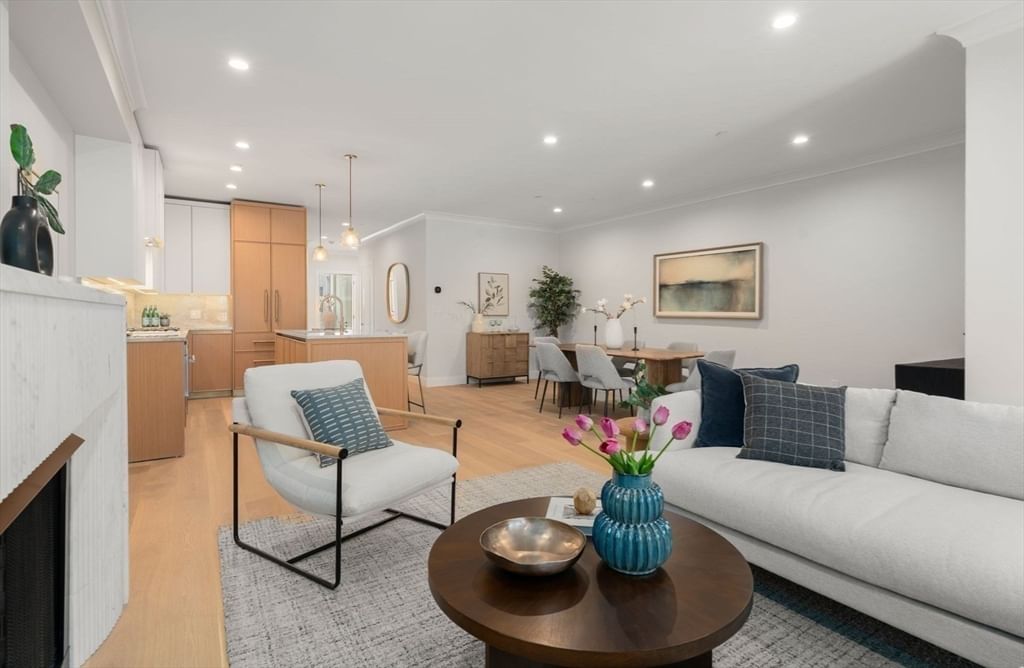
Living in the South End: The Essential Guide for Young Professionals
Explore South End’s walkable brownstone vibe: 97 Walk Score, $3,604 median 1-bed rent, SoWa arts, Tremont dining, Orange/Silver Line access.
Written ByAndrew McKinney
PublishedOctober 17, 2026
I'm Andrew McKinney, a JD/MBA attorney and broker helping buyers and sellers in Boston, Newton, Cambridge and beyond. Let's talk, from first search to closing. Serving Boston, Brookline, Cambridge, Arlington, Needham, Newton, Waltham, Lexington, Wellesley, Medford, Dedham, Westwood and Natick, MA.
Few Boston neighborhoods feel as complete as the South End. Victorian brick rowhouses line the streets. Restaurants and galleries are packed in tight. Leafy residential squares offer a quiet retreat, and transit access ranks among the best in the city. If you're a young professional who wants to walk to dinner, bike to work, and come home to a historic block with real character, this guide covers what matters most: the vibe, the housing, the gathering spots, and the commute.
What Is It Like to Live in the South End as a Young Professional?
The South End is lively and highly walkable, yet its residential side streets are noticeably calmer than the downtown core. Busy commercial corridors like Tremont Street and Washington Street sit just a turn away from quiet brownstone-lined blocks and garden squares.
This is a neighborhood for people who like to be out and about. With a Walk Score of 97, which earns it the label "Walker's Paradise," most daily errands happen on foot: coffee, groceries, the gym, a weeknight dinner. The numbers bear it out:
•40.8% of residents walk to work.
•45.2% of households don't own a car.
•Commutes average just 18 minutes.
Is the South End busy or quiet?
It depends on the block. My office is in Back Bay, and clients who tour both neighborhoods often tell me the South End feels quieter and more residential, with streets that are simply more pleasant to walk. It doesn't sacrifice much for that calm, either. There's still no shortage of places to eat and drink.
•Weekday evenings: Tremont Street fills with restaurant and happy-hour crowds.
•Weekends: The energy shifts to the SoWa district, the parks, and the brunch spots.
•Late nights: The squares, including Union Park, Rutland Square, and Concord Square, grow considerably quieter.
Who lives in the South End?
The South End skews young, educated, and professional. Here's a closer look:
•The median age is about 34.5.
•Residents aged 25–44 form the largest group, at roughly 8,815 people.
•96.8% of the working population holds white-collar jobs.
•Median household income for residents aged 25–44 is about $146,179.
•Nearly half of households (47.4%) are people living alone, a clear sign of how many singles and early-career professionals call the neighborhood home.
•About 60.7% of homes are renter-occupied, which means a steady stream of newcomers. The social, welcoming atmosphere is easy to step into.
How expensive is it to rent in the South End?
The South End is a premium rental market. A one-bedroom costs more here than in Back Bay, but less than in the Seaport. The median one-bedroom rent sits around $3,604. That places the South End near the top of Boston's young-professional neighborhoods, though still well below Seaport/Fort Point at $4,270.
Young Professional 1BR Rent Comparison
Median one-bedroom rents across Boston neighborhoods popular with young professionals, highlighting the South End as a premium-but-not-Seaport option for urban renters.
Median one-bedroom rents across Boston neighborhoods popular with young professionals, highlighting the South End as a premium-but-not-Seaport option for urban renters.
Well-priced one-bedrooms draw strong interest, so have your paperwork ready before you tour.
What Are Condos and Townhomes Like in the South End?
Most South End housing consists of condos carved out of 19th-century bow-front brick rowhouses. Mixed in are multi-level townhomes and a growing number of modern lofts and mid-rise buildings, particularly toward SoWa and Harrison Avenue.
The South End is recognized as one of the largest intact Victorian rowhouse districts in the country:
•Construction began in 1849.
•It joined the National Register of Historic Places in 1973.
•It became a Boston Landmark District in 1983.
That landmark status protects the streetscape. It also means exterior changes must pass architectural review, which is worth keeping in mind if you plan to renovate.
What housing styles will I find in the South End?
•Brownstone condos: The classic South End purchase. Think bay windows, original moldings, marble fireplaces, and tall parlor-level ceilings. Garden-level units often include private patios, and top floors frequently come with roof decks.
•Multi-level townhomes and duplexes: These typically combine two floors of a rowhouse and offer private outdoor space in front and back. Buyers who want the feel of a house without exterior maintenance tend to love them.
•Industrial lofts: Converted warehouses and factories near SoWa and Harrison Avenue deliver open floor plans, exposed brick, and soaring ceilings.
•Modern mid- and high-rises: Newer buildings along Washington Street and the neighborhood's edges provide elevators, amenities, and sometimes garage parking. Their efficient, low-maintenance layouts suit busy schedules.
Are there single-family homes or large lots in the South End?
Single-family homes are rare, and lots are small. Rowhouses usually sit on narrow, deep urban lots, typically with a small rear garden or patio instead of a yard.
An entire brownstone is a true luxury. Only 9 single-family homes sold year-to-date as of October 2026. Union Park holds the neighborhood's record sales at $12.1 million, $10.7 million, and $10.2 million. According to FY2026 assessments, West Brookline Street is the priciest street, with an average value of about $1.92M, followed by Claremont Park and Rutland Square.
How much do condos cost in the South End?
South End condos generally sell in the high six to low seven figures. At roughly $1,180/sqft on average, they come in meaningfully below Back Bay on a per-square-foot basis.
The market cooled modestly after peaking in 2023. Inventory is healthier now than it was a few years ago, so today's buyers have more choice and more room to negotiate than they did during the 2021–2022 frenzy.
South End Market Snapshot — October 2026
Headline housing numbers for a young-professional read on South End: premium condo pricing, ample active inventory, strong sale-to-list performance, and a luxury brownstone tier above the condo market.
Five-year condo pricing shows the South End holding above the million-dollar mark after a sharp rise from 2021 to 2023, with slight cooling in 2024–2025.
Five-year condo pricing shows the South End holding above the million-dollar mark after a sharp rise from 2021 to 2023, with slight cooling in 2024–2025.
When I walk first-time buyers through South End listings, the range usually surprises them. A compact two-bedroom on Tremont Street might list in the $700Ks, while a sunny two-bedroom on a square can run about $1.5M. Expansive triplexes climb well beyond that. Here, the block, the floor, and the outdoor space shape value just as much as square footage.
What do HOA fees and property taxes look like for South End condos?
HOA fees in small brownstone associations tend to be modest. Full-service buildings cost considerably more. A few recent examples from self-managed or small rowhouse associations:
•82 East Brookline:$164/month
•692 Tremont:$556/month
Full-service luxury buildings across the city can run $2,000–$4,000/month.
Small associations come with a trade-off: you and your neighbors share decisions about roofs, masonry, and reserves. I always review the condo documents and budget closely, because a low fee isn't a bargain if the reserve fund is thin.
Taxes:
•Boston's FY2026 residential rate is $12.40 per $1,000 of assessed value.
•Owner-occupants should apply for the residential exemption, which removes $351,108 from the assessed value and saves roughly $4,354 a year.
•On an average-priced condo, that means an annual bill of about $18,550 for an investor versus $14,196 for an owner-occupant.
Closing costs:
•The Massachusetts deed excise tax is $4.56 per $1,000.
•Budget 1–2% of the purchase price for total closing costs.
•Many South End purchases will likely exceed the conforming loan limit, so plan on jumbo financing.
Where Do People Gather in the South End?
Social life in the South End revolves around the SoWa Art & Design District, the restaurants along Tremont Street, and a network of parks, squares, and community gardens. Boutique gyms and coffee shops fill in everything in between.
What is the SoWa district in the South End?
SoWa (short for South of Washington) is the neighborhood's hub for art and weekend markets.
•SoWa Artists Guild, 450 Harrison Avenue: Home to 20+ galleries and 80+ artists. Its monthly First Friday open studios double as a relaxed networking night.
•SoWa Open Market: Open Sundays, 10 a.m. to 4 p.m. in season, it draws crowds in the low thousands for local makers, vintage finds, and food trucks.
Where are the best restaurants in the South End?
Tremont Street's "Restaurant Row" is the heart of the South End dining scene. It stretches from chef-driven bistros to tapas bars and cocktail lounges, with more options spilling onto Washington Street and Shawmut Avenue.
This is where residents host friends, celebrate promotions, and eventually settle on a regular spot. For everyday provisions, Formaggio Kitchen - South End is a neighborhood staple for cheese, wine, and dinner-party supplies.
What parks and green space does the South End have?
For such a dense neighborhood, the South End has a surprising amount of green space. It counts about 30 parks, eleven residential squares, the Southwest Corridor Park, and 12+ community gardens.
For many young residents, Peters Park is the social anchor. It offers a dog park, an athletic field, a basketball area, a tennis facility, and a playground. On weekend mornings, the dog run is one of the easiest places in the neighborhood to meet people. Ringgold Park, Titus Sparrow Park, and Rotch Playground round out the options.
Is the South End good for fitness and coffee culture?
Absolutely. The South End is packed with boutique fitness studios, strength gyms, and specialty coffee shops. As a former competitive tennis player, I always enjoy pointing out to clients that the Peters Park courts are a short walk from much of the neighborhood. Plenty of residents build their days around a morning workout, a coffee on Tremont, and a walk to the office.
How Is the Commute from the South End to Downtown Boston, the Seaport, and Cambridge?
Getting around from the South End is easy. The Orange Line, the Silver Line, Back Bay commuter rail, and several bus routes are all within walking distance, and many residents simply walk or bike to work. With transit and bike scores both above 90, a car-light lifestyle is entirely realistic.
South End Mobility Scores
A car-light lifestyle is one of the South End’s strongest selling points, with walk, transit, and bike scores all above 90.
A car-light lifestyle is one of the South End’s strongest selling points, with walk, transit, and bike scores all above 90.
•Orange Line: Back Bay and Massachusetts Avenue stations sit along the neighborhood's western edge, with direct service to Downtown Crossing, State Street, and North Station.
•Silver Line SL4 and SL5: Both run down Washington Street through the center of the neighborhood toward Downtown Crossing and South Station. From South Station, you can transfer to the Red Line or head to the Seaport.
•Green Line: Copley station is a short walk from the Back Bay side of the neighborhood.
•Commuter Rail and Amtrak: Back Bay Station handles regional and intercity travel.
•Buses: Routes 1, 8, 10, 11, 19, 47, and 170 cover crosstown connections. The Route 1 bus travels up Massachusetts Avenue and across the river into Cambridge, making it a popular choice for anyone headed to MIT or Central Square.
How do South End residents get to Cambridge and the Seaport?
•Cambridge: Ride the Route 1 bus up Mass Ave, or transfer to the Red Line from the Orange or Silver Line.
•Seaport: Take the Silver Line through South Station.
•Back Bay and Copley Square: Most of the neighborhood is within walking distance, just a short stroll across Columbus Avenue.
Can you bike or drive from the South End?
Biking is a strong option. The Southwest Corridor Park path and dedicated bike lanes link the South End to Back Bay, Jamaica Plain, and downtown. Nearby Complete Streets work along Boylston Street is also upgrading signals and bicycle and pedestrian accommodations on the route into Back Bay.
Boylston Street Complete Streets Project
Nearby public-realm and mobility improvements matter for urban professionals who rely on walking, biking, and transit connections around the South End and Back Bay edge.
Project ID606453
ProgramComplete Streets
Implementation Year2025
ScopeImprove the roadway cross section, signals, and bicycle and pedestrian accommodations
Driving works well for weekend getaways. Both I-90 (the Mass Pike) and I-93 are just minutes away.
Parking, however, is the real cost of owning a car here. As of early 2024:
•On-street resident permits were free, but spaces are hard to come by.
•Off-street parking rented for about $300–$400/month.
•Deeded spots sold for roughly $100,000–$200,000.
When buyers ask whether a deeded space is worth it, my honest answer depends on how often they actually drive. In the South End, many people discover they don't need to.
Is the South End the Right Neighborhood for You?
The South End is a strong fit if you want historic architecture, a walkable lifestyle built around restaurants and the arts, and quick access to downtown, all at a per-square-foot discount to Back Bay.
•Renters: Expect premium pricing and strong competition for well-priced one-bedrooms.
•Buyers: Today's more balanced condo market leaves room to negotiate. A careful review of condo documents, HOA reserves, and the owner-occupant tax exemption will help protect your investment.
Whether you're signing your first lease on Tremont Street or buying a garden-level brownstone condo off a quiet square, the South End delivers a rare combination: big-city energy with a genuine neighborhood at its heart.
Is the South End in Boston, MA a good place for families to live?
The South End can work well for families who want an urban, walkable lifestyle with access to parks and playgrounds. The neighborhood has about 30 parks, eleven residential squares, the Southwest Corridor Park, and more than 12 community gardens.
Peters Park is a major neighborhood amenity with a playground, athletic field, basketball area, tennis facility, and dog park. Housing is mostly condos, townhomes, and rowhouse-style residences rather than large-lot single-family homes.
What types of condos and townhomes are common in the South End, Boston, MA?
Most South End housing consists of condos carved from 19th-century bow-front brick rowhouses. Common features include bay windows, original moldings, marble fireplaces, tall parlor-level ceilings, private patios in garden units, and roof decks on some top-floor units.
The neighborhood also has multi-level townhomes and duplexes, industrial lofts near SoWa and Harrison Avenue, and newer mid- and high-rise buildings along Washington Street and neighborhood edges.
Are single-family homes common in the South End, Boston, MA?
Single-family homes are rare in the South End, and lots are typically narrow, deep, and urban. Most properties have a small rear garden or patio rather than a traditional yard.
Whole brownstones sit in the neighborhood’s luxury tier. Only 9 single-family homes had sold year-to-date as of October 2026, with Union Park holding record sales of $12.1 million, $10.7 million, and $10.2 million.
How much do South End condos cost in Boston, MA?
South End condos generally sell in the high six to low seven figures, with an average of roughly $1,180 per square foot. Pricing is meaningfully below Back Bay on a per-square-foot basis.
A compact two-bedroom on Tremont Street can list in the $700Ks, while a sunny two-bedroom on a square can run around $1.5 million. Block, floor, outdoor space, and building type all have a major impact on value.
What are HOA fees and property taxes like for South End condos in Boston, MA?
HOA fees in small brownstone associations are often modest, with recent examples ranging from $164 to $556 per month. Full-service luxury buildings can cost much more, sometimes $2,000 to $4,000 per month citywide.
Boston’s FY2026 residential tax rate is $12.40 per $1,000 of assessed value. Owner-occupants should apply for the residential exemption, which removes $351,108 from assessed value and saves about $4,354 per year.
How is the commute from the South End in Boston, MA?
Commuting from the South End is convenient because the Orange Line, Silver Line, Back Bay commuter rail, Amtrak, and several bus routes are within walking distance. The average commute is about 18 minutes, and 40.8% of residents walk to work.
The Orange Line is accessible at Back Bay and Massachusetts Avenue, while the Silver Line SL4 and SL5 run along Washington Street toward Downtown Crossing and South Station. Route 1 connects up Massachusetts Avenue toward Cambridge.
Do you need a car in the South End, Boston, MA?
Many South End residents live comfortably without a car. The neighborhood has a Walk Score of 97, transit and bike scores above 90, and 45.2% of households do not own a car.
Parking is the main cost of car ownership. Resident permits were free as of early 2024, but spaces are competitive; off-street parking rented for about $300–$400 per month, and deeded spaces sold for roughly $100,000–$200,000.
What should families know about schools when considering the South End in Boston, MA?
School fit should be evaluated separately from the South End’s housing, commute, and lifestyle advantages. The neighborhood’s clearly established strengths are walkability, transit access, parks, playgrounds, and historic condo and townhome housing.
Families considering the area should weigh those neighborhood factors alongside their own school requirements before renting or buying.